

Hi friends!
Eddie and I got to talk through everything that happened this week, including where we think the paddle market is headed this year.
We also cover the big news around ALW’s paddle sponsorship and a few updates I’m making to how I test paddles.
Plus, our first impressions of a new paddle from Mark Pickleball that looks really promising.
Let’s dive in!
In this week’s email:
ALW Signs with Franklin
Mark 02 R3 First Impressions
Big Upgrade to the Database
2026 Paddle Predictions
Read time: 6 mins
PICKLEBALL NEWS
ALW Signs With Franklin
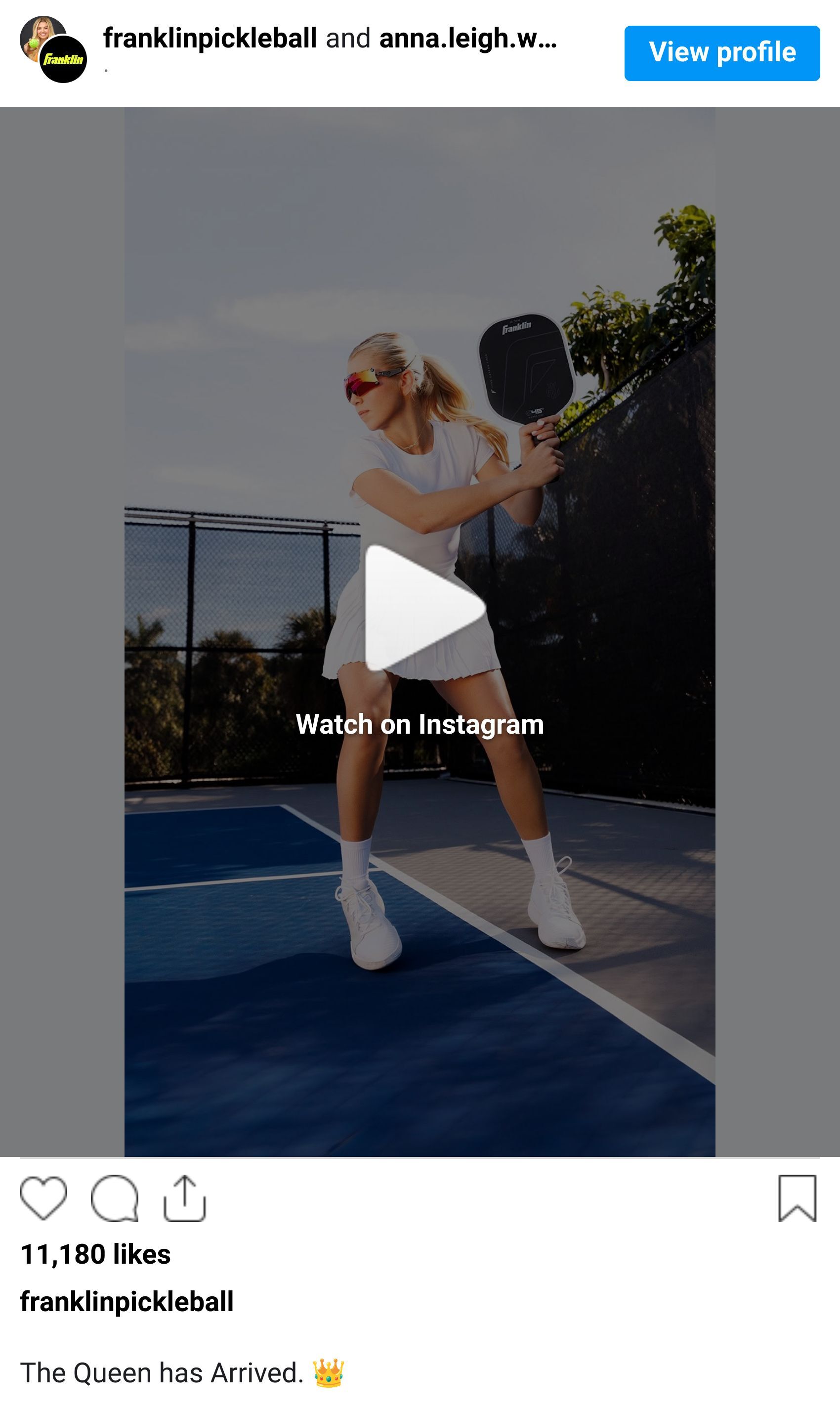
Anna Leigh Waters has officially signed with Franklin, and she now has her own signature paddle.
The design looks very familiar. It closely mirrors her previous PaddleTek model, featuring a widebody shape and a 12.7 mm thickness.
There’s still some buzz around a potential Nike apparel deal, but for now, that part of the story is very much a wait-and-see
PADDLE OF THE WEEK
Mark 02 R3 First Impressions

We got our hands on the new Mark 02 R3, a new full-foam paddle from Mark Pickleball that’s coming out in late January. So far, this paddle is promising.
Core Design
The Mark 02 R3 uses an elongated shape and a fully floating EPP foam core, surrounded by EVA foam. The EPP center does not expand all the way to the edges, which helps the paddle feel more forgiving.
Inside the paddle, there are voids in the foam. These help control weight and flex. The part I found most interesting is near the neck.
The neck itself stays stiff and stable, but there’s a flex point just above it. That adds a little spring and dwell without making the paddle feel floppy or unpredictable.

Because of this layout, the paddle reminds me of the Enhance Duo, but it feels a little less dense and slightly more hollow, with a bigger usable sweet spot. It avoids the mushy feel that some full-foam paddles can have.
I need more time with it to nail down the firepower, but I didn’t feel like it was lacking in that department, and it had good feel and forgiveness.
For an elongated paddle, the sweet spot is surprisingly large, and it extends lower toward the throat, which is usually a dead area on paddles like this. That made it easier to play consistently, especially on off-center hits.
Even though this is a denser full-foam paddle, it does not feel mushy. I still feel connected to the ball, and shots feel clean and predictable. There’s a slight springy response, but it stays controlled.
Compared to something very stiff and hollow like the Boomstik, this feels denser, softer, and more controlled. Compared to very dense paddles like the TruFoam Genesis, I think this is an easier entry into full foam for most people.
The Kevlar face adds good grip, and the spin felt strong. I had no problem shaping the ball on topspin or slice.
UPDATES TO PADDLE TESTING
Big Upgrades to the Database

The past couple of years, I’ve been building a paddle database where I run a bunch of tests on paddles and present metrics like power, spin, swing weight, and feel.
As the database has grown, I’ve learned that some of the tools I started with don’t work as well at scale. So I’m making big changes and upgrades this year, like moving away from percentiles and taking away radar charts.
Here’s why.
Why I’m moving away from percentiles to z-scores

Percentiles worked well at the beginning, but they’re becoming misleading.
The reason is clustering. Most paddles sit very close together in certain metrics, especially spin RPM. When the data is that tight, very small real-world differences get stretched into large percentile gaps. That makes paddles look far more different than they actually are.
For example, the Perseus Pro IV measured 2198 RPM, while the Perseus 3S came in at 2148 RPM. That’s only a 50 RPM difference.
But when you convert that into percentiles, the Pro IV lands at the 71st percentile and the 3S drops to the 55th percentile. On paper, that makes the Pro IV’s spin look dramatically better, even though the real-world difference is minimal.
In short, the math exaggerates the separation when the performance is nearly the same.
Switching to z-scores will help simply show how far a paddle is from the average.

Bar graph with z-score data
If you look at the bar graph using z-score data, you can see what’s actually happening. There is a small difference in spin, with the Pro IV sitting slightly above the 3S, but it’s represented proportionally. The gap exists, but it isn’t exaggerated the way percentile rankings make it seem.
That’s the core problem: percentiles amplify tiny differences when paddles are already performing in the same range.
Big upgrade to spin testing

Footage from the FREEFLY Wave High-Speed Camera
This is the part I’m most excited about.
I’m moving spin testing closer to lab-style methods: the paddle is clamped at a fixed angle, a ball is fired at a controlled speed, and spin is measured directly off the face.
I also picked up a Freefly Wave high-speed camera, which lets me tighten accuracy and actually study things like dwell time instead of guessing.

The goal here is cleaner data, clearer comparisons, and fewer misleading conclusions.
And yes, we’re absolutely going to use it for fun too. We’ll finally be able to do the testing of safety glasses with the ballistic gel head, complete with super slo-mo!
Why radar charts are going away
Radar charts look cool, but they create a common misunderstanding.
People see a bigger shape and assume it means a better paddle. That breaks down fast when some metrics, like swing weight and balance point, are preference-based, not performance upgrades.
I’m replacing radar charts with bar charts that show the full distribution for each metric. This makes it easier to see where a paddle actually sits without your brain jumping to the wrong conclusion. Check it out!

A clearer swing metric
I’m bringing back an old idea with a better name: Swing Resistance Index.
Higher score means the paddle is harder to swing
Lower score means it’s easier to swing
Simple and intuitive.
LATEST GEAR GOSSIP
2026 Paddle Predictions
In 2025, we saw a lot of fun innovation in the paddle world, and a lot of controversy. We had new core tech, new rules, paddles getting flagged and sunset, and a whole lot of arguing about what’s “legal,” what’s “fair,” and what’s actually happening on court.
The two big things behind all of this are:
Foam cores are taking over. They usually give you a bigger sweet spot, the manufacturers can ‘tune’ the power easier than honeycomb polypropylene, and they tend to be more durable than some older cores.
USAP’s PBCOR has left a lot of paddle manufacturers scratching their heads. A paddle can “pass” the lab limit, but that doesn’t always match what people feel on court. Or paddles that don’t hit that hard failed PBCOR. But companies are learning the idiosyncrasies of USAP’s system, and they are getting better about maxing out ‘real’ power without getting slapped by testing.
So with that as the backdrop, here’s what Eddie and I think is coming in 2026.
1) What’s going to drive paddle innovation in 2026?
We both think the focus shifts.
For the last couple years, the headline was basically: “Who can make the most powerful paddle?”
But Eddie’s take (and I partly agree) is that power stops being the main story, because PBCOR limits put a ceiling on how crazy things can get. So instead, brands start chasing stuff that actually makes a paddle easier to play with: forgiveness, sweet spot, and overall feel. I do think power will be an important driver of innovation, but not as much as the last two years.
My prediction is that innovation comes in two waves:
Early 2026: I think spin durability becomes the obsession
This is the big one.
A lot of paddles can feel super gritty and spinny out of the box… then the surface wears, and the magic starts fading. So the new arms race is: How do we make spin last longer?
We’re already seeing it with things like Infinigrit, Diamond Tough Grit, and similar ideas from Spartus. And I’ve heard multiple brands are working on their own version. I know 11SIX24 is working on it. I know Chorus is working on it. I wouldn’t be surprised if we see a bunch of these hit in Q1 and Q2.
Late 2026: Core layouts get more creative
Once the spin durability stuff becomes more normal, I think we’ll see companies experiment more with the core itself.
That means:
different foam types
different foam densities
smarter weight placement inside the paddle
designs that stretch the sweet spot and fine-tune feel
And yes, power is still going to matter, but the real goal won’t be “max PBCOR.” The real goal is: How do you get Boomstik-level power and still pass testing? Because people still want that.
2) Will foam be king by the end of 2026?
Yeah. 100%.
Eddie’s prediction is that honeycomb polypropylene becomes a tiny piece of the market. Not gone overnight, but way less common. Something like 90% foam, 10% honeycomb.
I agree with the trend, but I think honeycomb polypropylene has a more devoted fan base, so I’m gonna say more like 60-40 (foam-honeycomb).
One reason people still hesitate with foam is that the first big foam paddles, like the TruFoam Genesis, felt really different.
Some people tried one and thought, “This feels springy,” or “This feels mushy,” or “I don’t feel connected to the ball.” Totally fair.
But what’s changing now is that foam paddles don’t all feel the same anymore.
I’ve been mapping feel types, jokingly called the “feel wheel”. The point is simple: foam is finally spreading out into more styles. We already have floating full-foam paddles that still give you the sweet spot benefits, but play closer to what a lot of people liked about Gen 3 honeycomb paddles.
And at the end of the day, two things are hard to argue with:
Thermoformed full foam tends to give you a bigger sweet spot
Foam tends to be more durable
3) Is honeycomb polypropylene going to decline or make a comeback?
We think it keeps declining.
If you look at the whole pickleball world right now (not just gear nerds), I said it’s probably still something like 90% honeycomb, 10% full foam. Eddie thinks foam is already a bigger slice than that, closer to 40% Gen 4 in his circles.
Either way, we both agree it’s trending toward foam.
Even if the overall numbers move slowly because people keep using what they already own, new purchases are going to tilt toward foam even faster.
Because once someone finds a floating full-foam paddle that matches the feel they like, the reaction is usually:
“Oh… this is better. Bigger sweet spot. Plays great. And it doesn’t crush in two weeks.”
That’s the moment where the switch happens.